
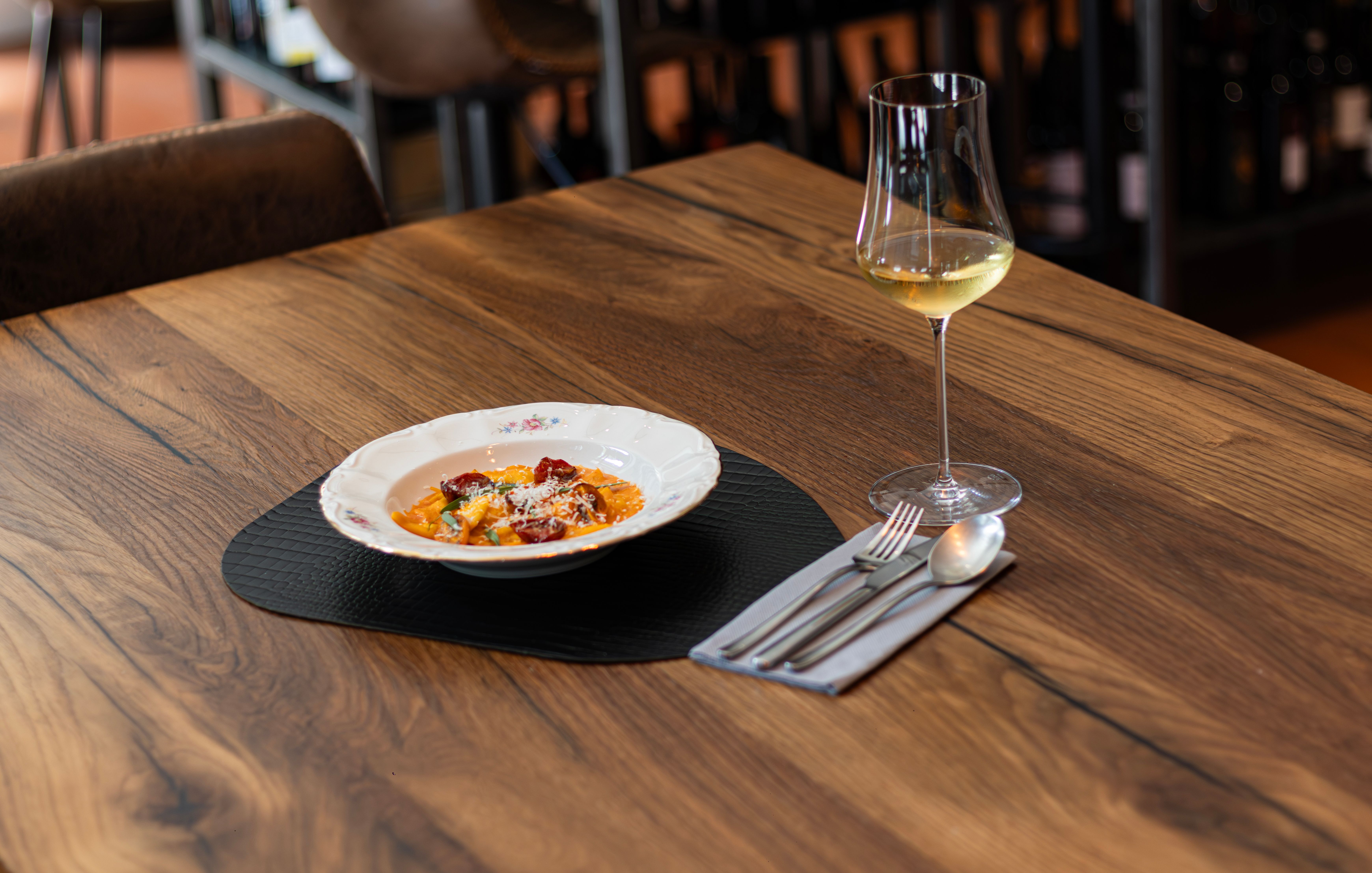
The advice to match rich food with acidic wine is repeated everywhere and explained almost nowhere. The mechanism is physical and takes place on the surfaces of the mouth.
Fat leaves a film behind
Fatty food deposits a layer across the tongue and palate that persists after swallowing. That film sits between whatever arrives next and the receptors underneath it.
The result is a progressive dulling, where the third mouthful of a rich dish registers less clearly than the first. Appetite falls with it, and the dish becomes heavy well before the plate is finished.
Anything that removes the film restores sensitivity, which is why a rich course eaten alone becomes tiring long before the plate is empty.
Acidity does the removing
Acidic liquid stimulates saliva, and saliva is the body's own mechanism for clearing residue from the mouth. The flow physically washes the surfaces.
Acidity also cuts through the fat directly, which is the same principle behind squeezing lemon over fried food.
A high-acid wine therefore resets the palate between mouthfuls, and the next bite lands as clearly as the first did.
Tannin performs a similar job differently
Tannin binds proteins and strips lubrication from the mouth, producing a scouring effect rather than a washing one.
Against a fatty, protein-rich dish this works well, since the fat and protein give the tannin something to bind to other than saliva.
The pairing is mutual: the food softens the tannin and the tannin clears the fat. Neither element is doing the other a favour so much as neutralising it.
Bubbles add a mechanical dimension
Carbon dioxide in sparkling wine produces a physical scrubbing sensation alongside the acidity, which is usually high in these styles.
The combination is unusually effective against fried and fatty food, and the tradition of pairing the two rests on that rather than on occasion.
The effect diminishes as the wine loses its bubble, which is one argument for pouring smaller measures more often.
Where the principle breaks
A wine that is only acidic, with little fruit or body behind it, can be stripped bare by a very rich dish rather than cutting through it.
The wine needs enough substance to survive the encounter, which is why weight matching still matters alongside the acid question.
The working formulation is that acidity handles the fat while body handles the intensity, and a pairing needs both to be right.